If you wish to access any of the below publications, please email me (see About page).
Books
Pregnant Women’s Sexuality in Early Modern England (Palgrave Macmillan, 2025), Genders and Sexualities in History series.
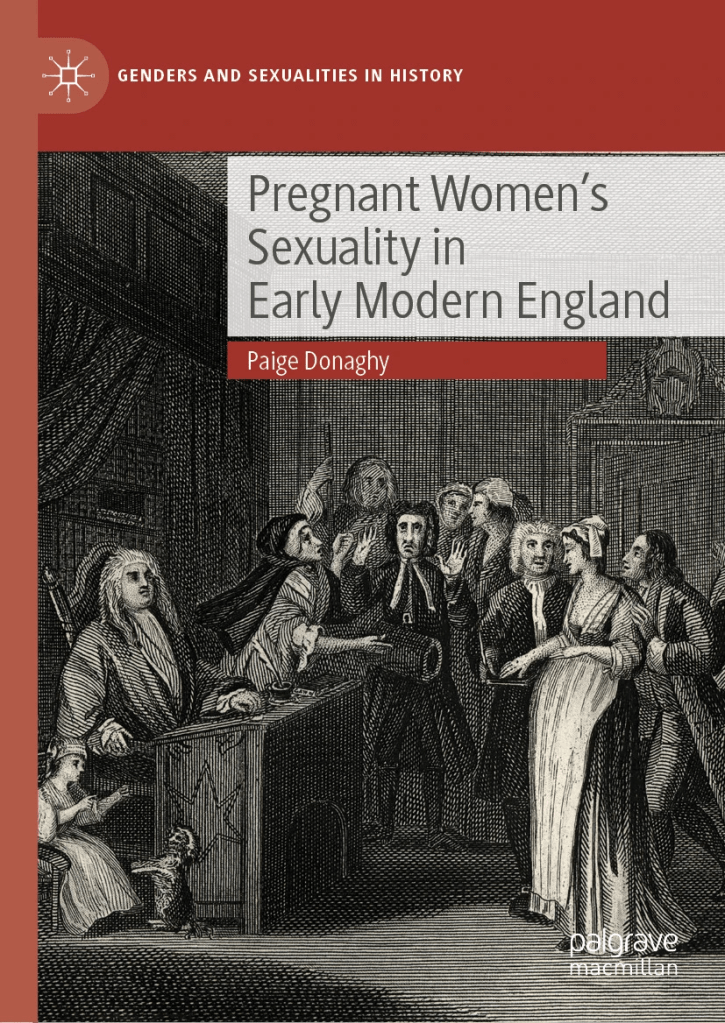
Pregnant women in the past had sex, yet we know nearly nothing about their sexual desires, or what people thought about sex during pregnancy. While there is much research on the sexual maternal body, studies of pregnancy and sex are lacking. This Palgrave Pivot provides the first history of pregnant women’s sexuality in England from 1550 to 1800, with discussion of Northern European perspectives on pregnancy sex. It explores a range of medical literature for descriptions of pregnancy and sexuality, including popular medical and midwifery books, as well as Latin scientific treatises. Alongside these texts, it considers popular culture materials including pornography, marital guides, and diaries and correspondence.
Drawing on methodologies from gender and queer history, the book attempts to locate pregnant women’s articulations of desire in this period. Moreover, the book reveals the paradoxical nature of early modern attitudes to sex and pregnancy: women’s gravid sexuality was portrayed as natural and desirable, but also excessive, potentially dangerous and disruptive to the foetus.
You can order a copy here: https://link.springer.com/book/10.1007/978-3-032-05652-8
Mola, False Conception and False Pregnancy in British Medicine, 1550–1850 (Durham University, 2026). “Science in Culture, c. 350 – c. 1750” Series.
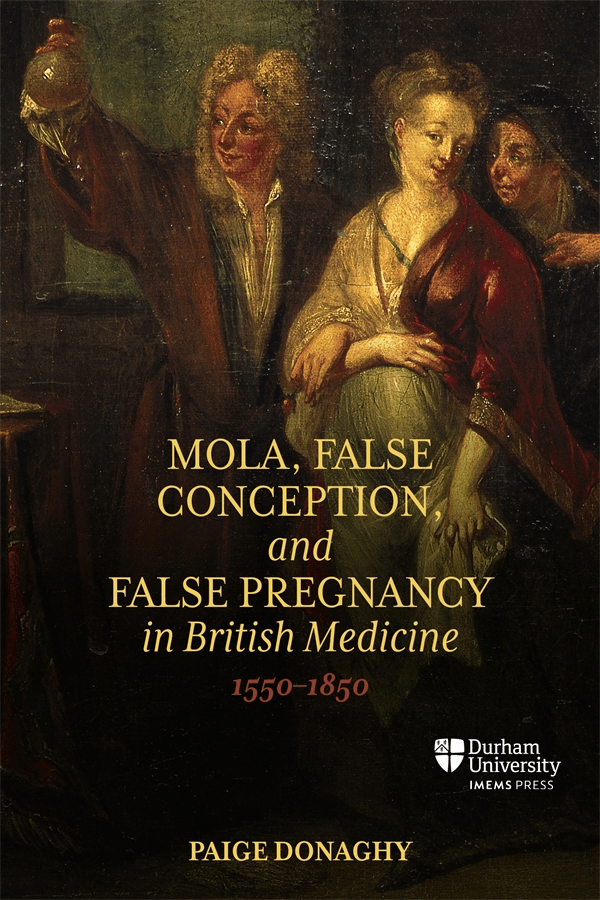
When reproduction defied certainty, it unsettled medicine, law, and belief. This book reveals how ambiguous pregnancies reshaped knowledge, emotion, and the cultural meaning of conception across centuries.
Across the long durée of the early-modern period, British medical practitioners and society at large were preoccupied with the elusive phenomenon of “false generation”-a term encompassing false conceptions, molae, moles, and spurious pregnancies. These non-foetal pregnancies, often indistinguishable from true gestations, generated profound uncertainty in medical, legal, and theological thought. Drawing on sources ranging from anatomical treatises and midwifery manuals to women’s letters, diaries, and court records, Donaghy traces how false generation shaped reproductive knowledge and understandings of the embodied experience. Through case studies such as Mary I and Joanna Southcott, the book highlights how reproductive ambiguity was not merely a private ordeal but a public and intellectual crisis. Engaging with figures like Galen, Jean Fernel, François Valleriola, and Frederik Ruysch, the book situates British debates within wider contemporaneous European contexts as well as a transhistorical development of medical knowledge.
By foregrounding uncertainty as both an emotional and conceptual force, this monograph contributes to the history of emotions, knowledge, and the body. It offers a field-defining account of how false generation unsettled assumptions about life, conception, and pregnancy, and how these ideas evolved into modern categories such as molar pregnancy. The book speaks directly to current debates in reproductive justice and healthcare, while presenting a compelling case for the historical contingency of reproductive knowledge and the diverse ways it has been shaped by cultural, scientific, and experiential factors.
You can purchase the book here: https://boydellandbrewer.com/book/mola-false-conception-and-false-pregnancy-in-british-medicine-1550-1850-9781914967177/
Co-authored Books
Lisa Featherstone, Cassandra Byrnes, Jenny Maturi, Kiara Minto, Renée Mickelburgh, Paige Donaghy, The limits of consent: Sexual assault and affirmative consent (Palgrave, 2024).
Book Chapters
Sellberg, Karin and Donaghy, Paige (2018). Feminist historiography. Gender: time. Edited by Karin Sellberg. New York, NY United States: Macmillan Reference USA. pgs. 67-84.
Peer Reviewed Journal Articles
Paige Donaghy and Cassandra Byrnes, “Reproducing History: A Review Of The Historiography Of Reproduction” Health & History Special Issue, forthcoming November 2024.
“The Secrets of the Placenta in European Anatomy and Midwifery, 1560-1700,” Isis: A Journal of the History of Science Society, 114, no.2 (2023): 249-271.
“Miscarriage, False Conceptions, and Other Lumps: Women’s Pregnancy Loss in Seventeenth- and Eighteenth-Century England”, Social History of Medicine, 34, no.4 (2021): 1138-1160.
“Wind eggs and false conceptions: thinking with formless births in seventeenth-century European natural philosophy” Intellectual History Review, 32, no.2 (2022): 197-218. [Published online 22 March 2021].
“Before Onanism: Women’s Masturbation in Seventeenth-Century England” Journal of the History of Sexuality, vol.29, no.2 (2020): 187-221.
Other (book reviews, blogs)
“Premodern Gender: Rethinking Categories – Series Introduction”, VIDA: Blog of the Australian Women’s History Network, August 21, 2024, available at: https://www.auswhn.com.au/blog/premodern-gender-series/.
“The Medical Humanities in Australia: Symposium Review”, The Polyphony: Conversations Across the Medical Humanities, 23 July 2024, available at: https://thepolyphony.org/2024/07/23/medhums-australia-symposium
Review: Birth Figures: Early Modern Prints and The Pregnant Body, written by Rebecca Whiteley. Early Science and Medicine 29 (2), 198-201.
Review: Alisha Rankin, The Poison Trials: Wonder Drugs, Experiment, and the Battle for Authority in Renaissance Science. History of Pharmacy and Pharmaceuticals 65 (2), 320-322, 2024
Review: The Shape of Sex: Nonbinary Gender from Genesis to the Renaissance by Leah DeVun. Parergon 40 (1), 251-253, 2023
“How a 16th century Italian anatomist came up with the word ‘placenta’: it reminded him of a cake” The Conversation Australia (September 2023) – article link here.
 Paige Donaghy